How Society Excludes People with ADHD by Design

Fashion is always sold to us as fun self-expression or putting your best foot forward. But let’s be honest: for someone with ADHD, clothes often feel like an obstacle course you’re forced to run every single day.
When people see an unironed shirt, a messy closet, or an outfit that feels a little chaotic, they tend to write it off as laziness or lack of effort. That misses the entire point. The way modern clothes are made, bought, and cared for is fundamentally at odds with how ADHD brains work.
1. The Physical Agony of "Just Clothes"
For a lot of people, putting on a shirt means you feel it for ten seconds and then forget about it. That’s not how an ADHD nervous system works. Research on tactile sensitivity shows that neurodivergent brains often lack that automatic filter; the nervous system doesn’t tune out constant physical stimuli.
The scratchy tag from hell: Stiff plastic tags, rough threads, and bulky interior seams don't just "sit there." They scream at you all day, pulling focus away from work, conversations, and whatever else you’re trying to do.
Suffocating "professional" clothes: Rigid waistbands that dig in when you sit, non-stretch dress shirts with stiff collars, and stiff blazers feel like physical traps. You spend half your mental battery just tolerating the fabric against your skin.
The wrong texture will ruin your entire day: If a sweater is even slightly itchy or a pair of pants traps sweat, it’s not just uncomfortable—it causes full-blown sensory overload.
2. Laundry Isn’t One Chore—It’s Eight
One of the biggest ADHD cliches is "the chair"—that spot where clean clothes go to sit for three weeks until you finally wear them again.
Neurotypicals treat laundry like a simple task. But in reality, laundry is an executive function marathon:
1. Sort colors and fabrics.
2. Stain-treat anything messy.
3. Start the wash.
4. The danger zone: Remember the wet clothes are sitting in the machine before they turn sour.
5. Move to dryer.
6. Remember to take them out so they don't wrinkle.
7. Fold or hang.
8. Put away in designated spots.
Fashion brands make this ten times worse by designing fragile clothes. Anything labeled "hand wash cold, lay flat to dry" or "dry clean only" is essentially doomed. If an item requires a special hanger, hand-steaming, or complex care, the process stalls. The clothes end up on the floor, and society treats it as a personal failure instead of bad user design.
3. Shopping: Overstimulation Meets the "ADHD Tax"
Getting new clothes should be easy, but the shopping process is set up to trigger ADHD vulnerabilities at both ends:
In-store chaos: Step into a department store or fast-fashion outlet and you’re hit with blaring music, blinding lights, overpacked racks, and twenty different choices per rack. Within fifteen minutes, decision fatigue kicks in and you just want to walk out.
The late-night dopamine scroll: When stores are too much, you turn to online shopping. Dopamine-seeking brains fall straight into the trap of targeted ads, sales timers, and 1-click checkouts.
The return window graveyard: You buy three sizes to see what fits. Two don’t work, or the material feels awful in person. Now you need to print a label, repackage the box, and drop it at a shipping counter before a deadline. Because of time-blindness and friction, the box sits by your front door for two months until the return window is gone. That’s real money lost to bad design.
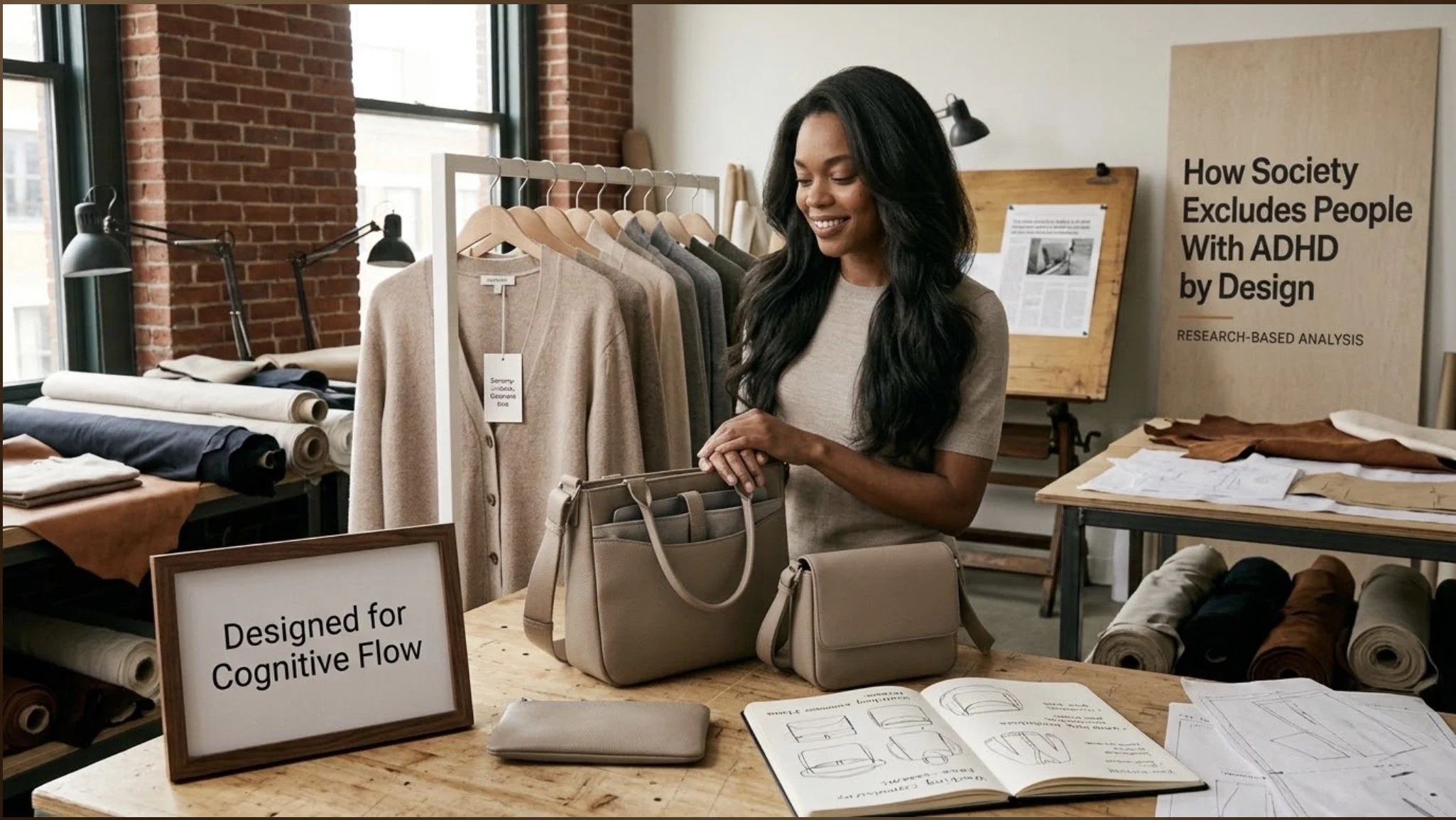
What Needs to Change:
Real inclusion isn’t about sacrificing aesthetics for medical-looking gear; it’s about recognizing that modern design ignores sensory and cognitive realities. To actually solve this, the conversation needs to expand beyond basic tees and look at the functional pieces people rely on every single day to feel grounded and organized:
The Power of the Sensory-Safe Layer: For someone managing temperature shifts and sensory overwhelm, a structured blazer is often a nightmare but a well-constructed knit bridges the gap between looking polished and staying regulated, offering a portable comfort zone you can take anywhere.
1. Sensory-First Construction: Tagless labeling, flat-fell seams, and breathable, high-quality fabrics that feel comforting rather than restrictive should be the baseline across all collections.
2. Regulation Through Wearability: Garments must balance visual polish with physical freedom. People shouldn't have to choose between looking sharp and feeling calm; clothing should support the nervous system, not fight it.
3. Low-Friction Maintenance: True durability means machine-washable, wrinkle-forgiving textiles that survive real-world laundry habits without requiring five extra steps.
4. Intuitive Functionality: Wearable design should actively assist executive function—prioritizing accessible pockets, clean visibility, and structures that reduce daily friction rather than adding to it.
Until fashion treats sensory regulation and cognitive ergonomics as core requirements rather than afterthoughts, people with ADHD will continue to pay an invisible tax just to get dressed.
-Carla Haughton, LMHC | THE NEURA ARCHITECT